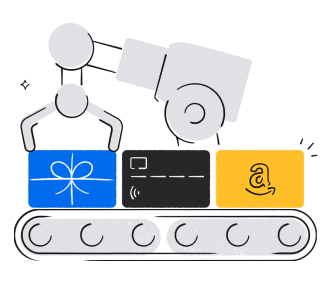
Why digital rewards win: Faster, cheaper, and easier than physical gifts
By Mindy Woodall●4 min. read●May 1, 2026

When a recipient lives across the country (or an ocean), a branded mug in a cardboard box doesn't say much beyond "we tried." A digital reward they can use the same day to buy something they actually want usually says more. Plus, digital rewards can cost less, and they get there without anyone having to print a shipping label.
That's the practical case for digital rewards, and it's why companies running employee recognition, research incentive, marketing reward, and sales & partner incentive programs stand to benefit from shifting away from physical gifts.
Key takeaways
Digital rewards are gift cards, prepaid cards, and other monetary incentives sent electronically, usually by email.
They're faster, cheaper, and easier to send globally than physical gifts like swag or merchandise.
Gift cards are the most popular non-cash incentive in North America, accounting for at least 43% of all incentives.
Digital rewards have a few trade-offs, and they sometimes feel less personal than a thoughtful physical gift.
For high-volume programs (hundreds or thousands of recipients), an API lets you send rewards programmatically without manual work.


What are digital rewards?
Digital rewards are incentives delivered electronically rather than physically shipped. In practice, that usually means either digital gift cards (Amazon.com, retailer-specific brands, etc.) or digital prepaid cards.
You'll see the terms "digital rewards" and "digital gifts" used pretty interchangeably. The difference, when there is one, tends to be context. Digital gift terminology usually shows up in consumer or peer-to-peer settings (sending a friend a $25 Starbucks eGift), while digital rewards is used by businesses for programs that send these at scale, like employee recognition platforms or marketing incentives.
This article focuses on business use cases like sending digital incentives to employees, customers, research participants, or program members.
Comparing digital rewards vs. traditional gift cards
In the past, if you wanted to give people gift cards, you’d buy plastic cards in a store. Digital versions of those same cards (sometimes called eGift cards or digital codes) now make up a fast-growing share of the market.
Here's how the two reward types compare across five different areas:
1. Speed
A digital reward can be sent in seconds and claimed immediately. A physical gift card has to be ordered (or bought in a store), sometimes mailed, and always physically delivered.
For time-sensitive programs like a thank-you after a sales call or a research participant payout, only the digital version of a gift card can fully meet the moment.
2. Global reach
Mailing physical gifts internationally can mean customs forms, shipping fees, and issues with delivery that can delay packages by weeks. Digital rewards skip all of that and can be distributed worldwide in just a few minutes.
3. Cost
Physical gifts carry fulfillment costs that digital rewards don't: production, packaging, shipping, returns, and labor to manage all of it. When you remove those costs, savings can flow into your actual rewards, meaning recipients get higher-value gifts for the same program budget.
4. User preference
Recipients appreciate the convenience of digital rewards. Gift cards are the leading non-cash incentive type in North America because recipients can pick out something they actually want rather than receiving an item a program manager guessed they might like.
5. Operational trade-offs
Physical gifts can feel more personal, especially for high-touch occasions like a milestone anniversary or an in-person client thank-you. Digital rewards are easier to scale, but can feel transactional if you don't put any thought into your message or presentation.
Pros and cons of digital rewards
Pros of digital rewards:
Sent and received in minutes instead of days
Work for international recipients without customs or shipping logistics
Lower total program cost (no fulfillment or inventory)
Easy to personalize at scale (with an incentive platform, recipients can pick their own card from a catalog)
Trackable, with delivery and redemption data you can pull into reporting
Cons of digital rewards:
Can feel less personal than a curated physical gift
Email delivery means some rewards can get lost in spam
Recipients with limited internet access may struggle to redeem them
Without thoughtful messaging, a digital reward can feel transactional
Conclusion
Digital rewards are the default for most modern incentive programs because they solve the problems physical gifts create such as slow delivery, high fulfillment costs, and logistical headaches for global recipients. They're not perfect for every situation (a thoughtful physical gift still wins for certain high-touch moments), but for most business use cases, the trade-offs favor digital options.