
You should (almost) always offer research incentives in return for a participant’s time and feedback. It’s the right thing to do. Plus, incentives make research easier and better.
Research incentives are rewards offered to study participants in exchange for their time and feedback. They typically take the form of cash, prepaid cards, gift cards, charitable donations, or physical gifts. Offering them is standard practice across UX research, market research, academic studies, and clinical trials.
The most effective incentive is often money. But, not always.
“I am of the mindset that you should always pay a [participant] for their time,” said Roberta Dombrowski, former head of UXR at User Interviews. “Because incentives actually encourage people to show up, and you're showing them that they're giving value.”
Key takeaways
Incentives work: They increase participation by up to 19% and often improve data quality too.
Best incentive type: Cash and cash equivalents suit most participants, but tailor your approach to the population.
How much to pay: It depends on study type, length, and participant profile. Our incentive calculator can help.
Ethical considerations: Calibrate rewards to participant burden, not study sensitivity, and take extra care with vulnerable groups.
Tax obligations: Research incentives are taxable. Collect W-9s before participants reach $2,000 in a calendar year.
How to send them: Platforms like Tremendous manage global payments, W-9 collection, and 1099 data in one place.
The role of incentives in research
Few people opt to participate in research on their own volition. Those who do tend to be the squeaky wheel. Researchers use incentives (like money, physical gifts, or rhetorical appeals) to motivate those who wouldn’t normally participate.
And, incentives work. A 2006 study shows that incentives increase study response rates by up to 19%.
“If you’re not compensating people for their feedback, one, they are a lot less likely to give you any in the first place. So you’re fighting to get it,” said Holly Cole, CEO of the Research Operations Community. “Two, the feedback that you do get is going to be lower quality, because free information is horribly biased.”
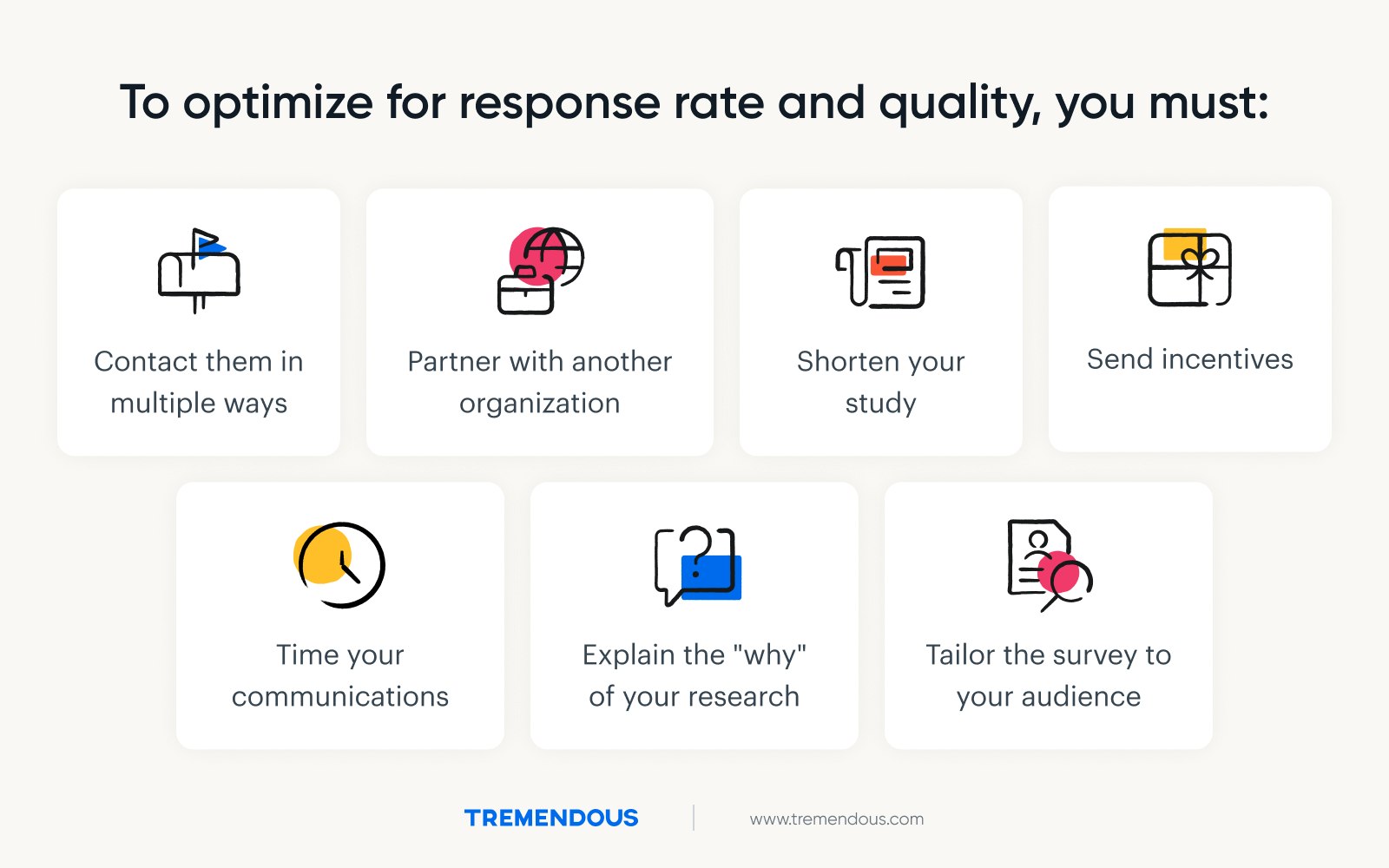
But incentives are just one of many factors that influence response rate, according to professor Don Dillman. Here are six ways to optimize for response rate and quality:
Contact participants in multiple ways: email, phone, and snail mail.
Simplify and shorten your study: attention spans are short, so cut your study to focus on the most salient information. Chances are, more people will participate (and finish) it.
Send research incentives: participants are giving you valuable feedback; compensate them for it.
Contact people multiple times: be strategic about how often and when you reach out; the cadence and frequency matter.
Explain the “why”: in all comms, explain the purpose of the survey, why the participant was selected, and other value-add details that prove the worthwhileness of your research.
Tailor tactics to your audience: meet people where they’re at; for instance, some populations may have less access to computers. Thus, mailed or telephone surveys are preferable.
Understanding the incentives in your arsenal
What’s the best incentive to use? Every study is different, and you should tailor your approach accordingly. The best appeal will vary depending on your target population, and participant populations will differ vastly by geography, culture, socioeconomics, and a variety of variables.
Monetary incentives are king
The industry was once reliant on checks, paper cash, and physical gift cards. The pandemic pushed many to adopt digital payment methods. That’s true of UXR, market research, academia, and clinical trials.
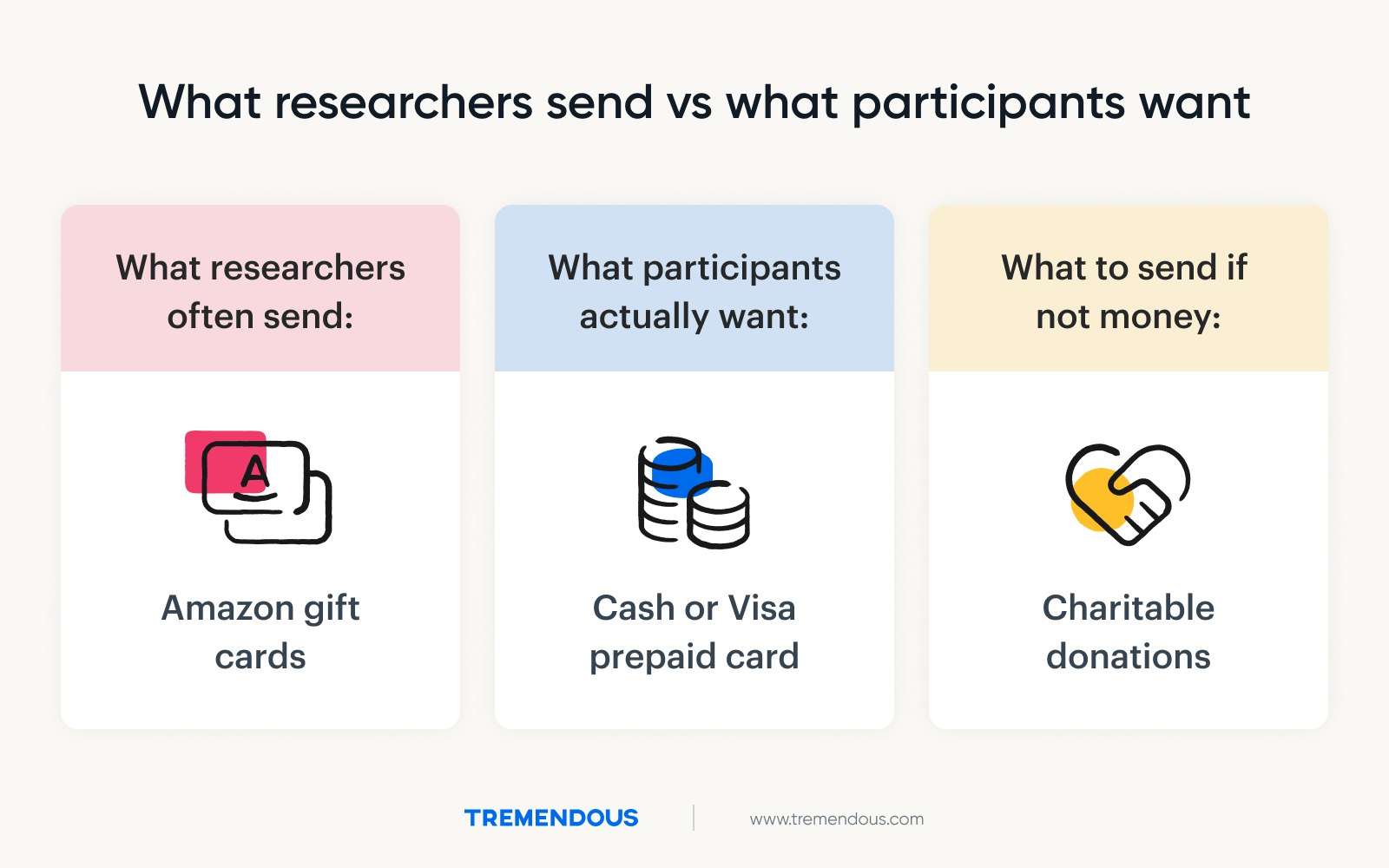
Researchers most often send Amazon.com Gift Cards. Tremendous conducted two surveys: one in 2022 of 368 Tremendous clients and a second in 2023 survey of 166 researchers. Both indicate an overwhelming use of Amazon.
We also conducted a conjoint analysis of recipient preference. If given a choice, recipients want a digital cash transfer or a Visa prepaid card over a gift card to a specific retailer.
Charitable donations are also a powerful research incentive. Often, recipients can’t accept incentives (or aren’t motivated by small dollar amounts). But a donation to a worthy cause might motivate.
“So many people disregard the fact that one in sixteen people in the United States works for the government,” Holly said. “You can’t pay them. But can you make a donation? Can you do volunteer days?”
Non-monetary incentives are equally important
Paying isn’t always appropriate, allowed, or within budget. Instead, try piquing intellectual curiosity: explain to participants how they’re furthering a body of knowledge; perhaps provide early or free access to the findings.
Alternatively, offer physical gifts: a sticker, a magnet, a tote bag, or exclusive swag. Perhaps an inexpensive electronic device. For small sample sizes, a personalized gift may be apt.
When to deliver research incentives
Gallup research points to the effectiveness of sending a few dollars along with your initial outreach. It found that sending just $1 upfront is the most cost effective.
As the theory goes, giving someone money in advance makes them feel obligated to reciprocate — thus improving research participation rates.
Yet, research incentives are frequently paid upon completion or using an escrow system. Companies that run large panels also often employ points systems to encourage people to participate in multiple studies. Others couple a small prepaid incentive with a larger payment upon completion.
Research might say prepaying is the way to go. But, anecdotally, it’s not as common as you might expect. We suspect that’s due to the fear of handing over money without a guarantee of getting anything in return.
A chance to win
Lotteries or sweepstakes can be effective research incentives, particularly for the budget-constrained.
People are 19% more likely to participate in a study that offers a lottery versus one with no incentive, and 26% are more likely to finish the study. And emails that highlight a lottery in the subject line and body raised response rates compared to emails that highlight the value of the survey itself.
Lotteries are ideal for tight budgets, as they turn incentives from a variable cost (dependent on sample size) to a fixed cost.
Tremendous is built for exactly this kind of flexibility. You can send digital cash transfers, Visa prepaid cards, gift cards, charitable donations, and more — all from one platform, to participants in 200+ countries. Whatever incentive fits your study, you can deliver it without switching tools or wiring funds manually.
How much should you pay research participants?
There's no universal rate. What you pay depends on the study type, how long it takes, and who you're recruiting. A five-minute screener survey warrants a very different incentive than a 90-minute moderated interview with a specialized professional. Here's a rough baseline to work from.
| Study Duration | Baseline (Survey) | Students (-20%) | High Earners ($200k+) (+46%) | Unemployed (Interaction/Payment Adjustments) |
|---|---|---|---|---|
| 15 Minutes | $26 | $21 | $38 | $47 |
| 30 Minutes | $48 | $38 | $70 | $69 |
| 60 Minutes | $69 | $55 | $101 | $90 |
These numbers come from our research on How Much to Pay Research Participants. As you can see, doubling the time commitment doesn’t need to double your budget. The longer your survey, the less additional money people expect per additional minute.
A few factors push rates higher. If you’re conducting interviews instead of surveys, add $8.66. If you’re asking about sensitive subjects (like health, finances, or personal trauma) for 30 minutes or more, add $3.40. For studies requiring prep ahead of time (study burden) or that pull from a niche pool of participants, expect to pay even more.
Use our research incentive calculator to get a recommendation based on your study type, duration, and participant profile.
Ethics of research incentives
Incentives, particularly money, can influence behavior, and that introduces a variety of ethical considerations.
What is undue influence — and how do you avoid it?
Undue influence (sometimes called undue inducement) occurs when an incentive is large enough to cloud a participant's judgment about the risks or benefits of a study. According to Researcher David B Resnik (2015) If the reward is too good to pass up, people may accept more risk than they would otherwise.
To avoid undue influence, calibrate the incentive to the time and effort required, not to the sensitivity or stakes of the research. Asking about health, finances, or personal trauma warrants a modest premium (our research suggests about $3.40 for 30+ minutes). It's not a reason to dramatically inflate the incentive. When in doubt, match the reward to the time commitment, not the subject matter.
Can research incentives create coercion?
No. According to Singer and Bossarte (2006), coercion has a specific definition: an overt threat of harm used to gain compliance. Research incentives offer a benefit, not a threat, which means they can never meet that bar.
What incentives can create is undue influence (see above), which can present ethical questions and affect the quality of your study.
How do incentives affect participant enrollment bias?
If certain populations are more motivated by an incentive than others, your sample will skew toward them, making it harder to draw conclusions that apply broadly.
A sample that doesn't represent the population limits how much you can generalize from your results. In some cases, it creates a dynamic where higher-income researchers effectively study lower-income groups, which introduces its own exploitative bias.
Tailor your incentive strategy to your target population. As Singer and Bossarte put it: "Using of a variety of appeals tailored to the needs of target populations offers the best hope for recruiting unbiased samples." Different populations respond to different types of rewards, and a one-size-fits-all approach will introduce bias by design.
Special considerations for vulnerable populations
Some participant groups require extra care. Children can't consent to research themselves, which means a financial incentive can pressure parents into enrolling kids in risky studies. The parent benefits financially while the child bears the risk. The Resnik paper suggests people in acute financial need face a similar dynamic: the money may override their honest assessment of the study's burdens.
Research has a dark history here. The Tuskegee Syphilis Study and other ethically dubious human trials forced the U.S. government to act. The National Research Act (1974) established oversight boards, and four years later, The Belmont Report codified three principles that still govern research ethics today
Respect for persons (informed consent)
Beneficence (do no harm)
Justice (non-exploitative procedures with costs and benefits distributed fairly)
These principles are now enforced through institutional review boards (IRBs), which oversee human-subject research at academic institutions, clinical trial sponsors, federal agencies, and other regulated entities. For pediatric research specifically, Resnik’s guidance is clear: parents should be reimbursed for time and travel, but incentives should not be "so large that they distort parental judgment.”
One practical step researchers take: drop the word "incentive" entirely. Atlassian and Airtable both call research incentives "thank-you gifts.” This framing shifts the dynamic from transactional exchange to genuine appreciation.
“We don’t want to think of it as compensation, or an incentive exchange,” said Adele Wallrich, research operations manager at Airtable. “We want to make it about gratitude, and fostering that relationship with users.”
Research incentives don’t have to be a headache
Incentives play a vital role in research, driving participation rates and likely improving response quality. Cash (or an equivalent) is usually the best incentive, but different populations are motivated by different things.
So, be flexible. Understand the ethical considerations and tax implications. Above all else, just find a way to show participants you appreciate their time and feedback.
Note: Tremendous can't provide tax or legal advice. While we've covered the basics of research incentives here, you should run your program plans past your company's tax advisors to be sure you’re compensating participants in a way that’s fully compliant and optimized for your situation.


