8 factors that keep research participants engaged (and what makes them check out)
By Mindy Woodall●5 min. read●Jun 8, 2026

Researchers spend a lot of time thinking about how to keep participants engaged with surveys. You want participants to give thoughtful answers so you can collect high-quality data, but attention checks can only go so far. So how do you make sure participants are giving it their all every step of the way?
We surveyed active research participants about their survey-taking experience to find out. Here’s what they shared about where they lose focus, what makes them rush, and what actually makes them stay on task.
Key takeaways
Most participants don’t lose focus until the final stretch of a survey. 55% say it happens at the 75% mark or later.
Repetitive questions, longer-than-expected length, and similar question formats are nearly tied as the top engagement killers.
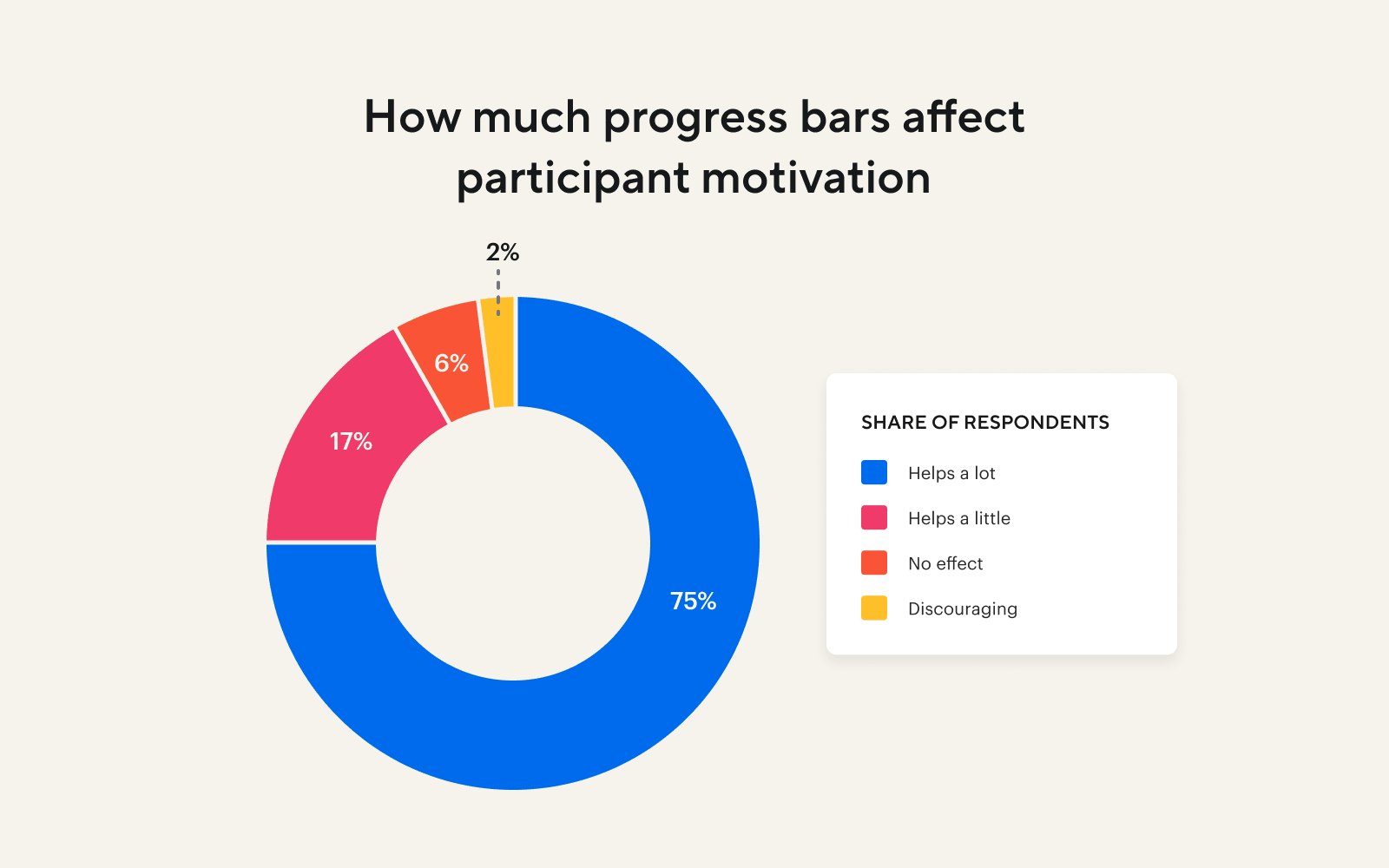
Progress bars are a near-universal motivator. 75% say progress bars help keep them engaged, and all respondents said they notice them.
Repetition can encourage participants to rush through questions. Technical problems also contribute to quitting.
Disengagement is fortunately reversible for most participants. Only 3% say that once they lose interest, it never comes back.
1. Most participants lose focus in the final stretch
Disengagement tends to happen in the back-half of a survey. 29% of our survey respondents said they typically lose focus about three-quarters of the way through, and another 25% said it happens near the end. Only 9% tend to lose focus in the first quarter.
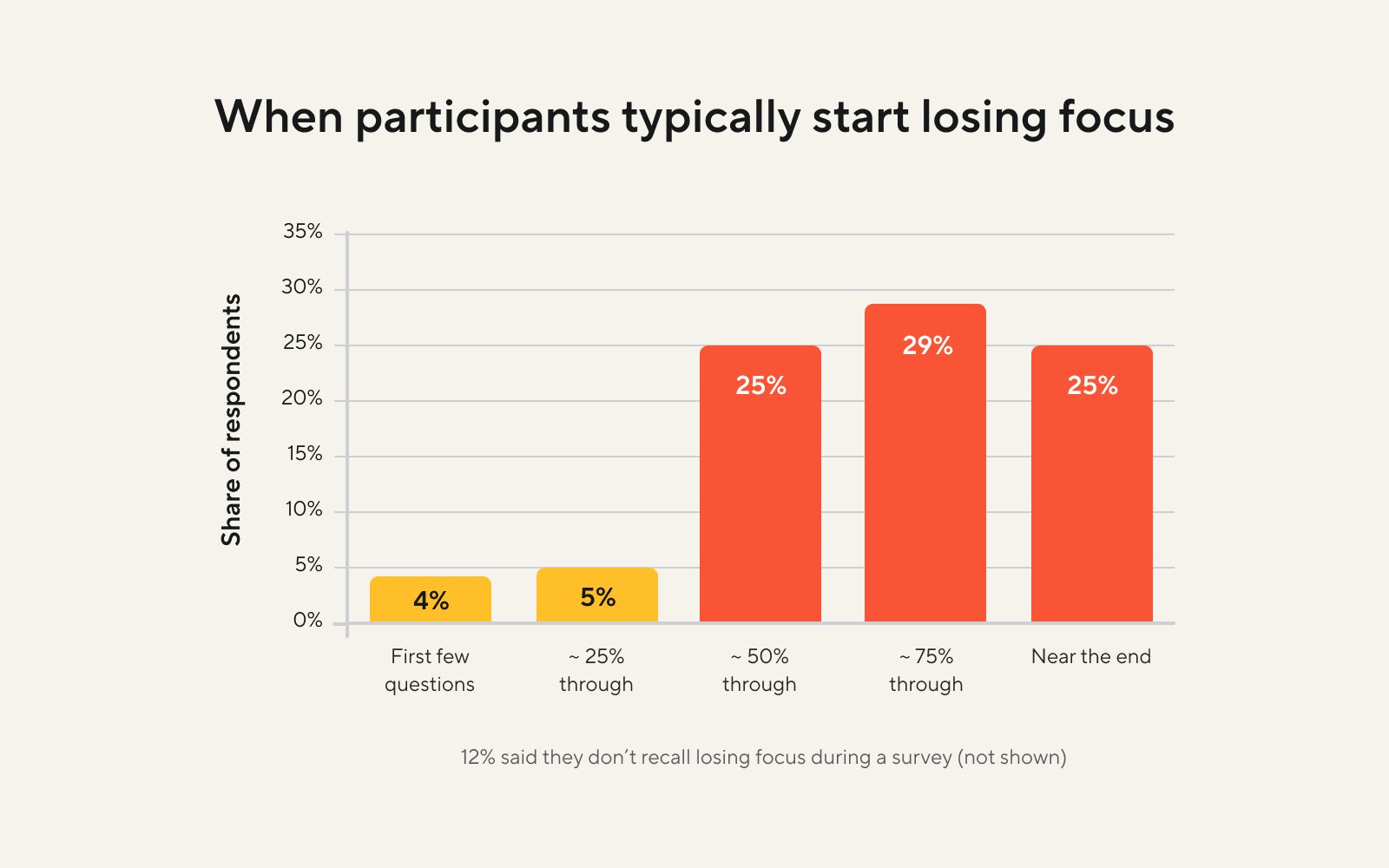
The takeaway: Your opening questions probably aren't the problem. Fatigue compounds, and the back half of your survey is where data quality is most at risk. If you're going to invest in tightening any section of a study, start there.


2. Repetition and length are the top engagement killers
When participants start losing focus, the triggers are remarkably consistent. 28% said the cause is realizing the survey is longer than they expected. 27% said they lose focus when questions start feeling repetitive. And 26% said they start to drift when they answer too many of the same types of questions in a row.
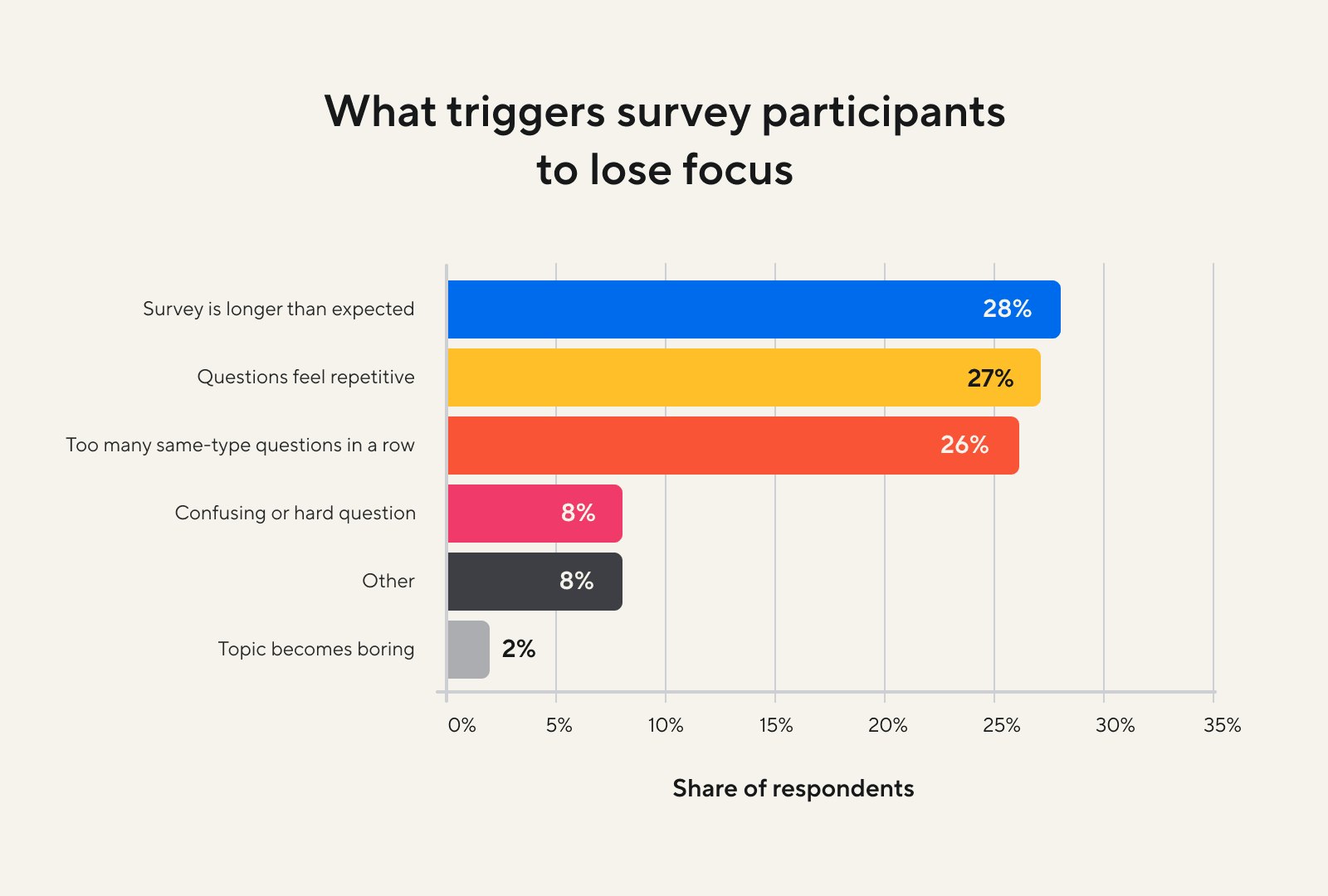
What didn't make the list is just as telling. Only 2% said they lose focus because the topic is boring. Monotony is a much bigger threat to engagement than the subject matter itself.
Key takeaway: Vary your question format. Fifteen Likert scales in a row will probably lose people, no matter how interesting the underlying topic is.
3. Progress indicators are nearly universal motivators
One of our clearest findings was that survey-takers like progress bars. 75% of respondents said a progress bar helps a lot with their motivation, and another 17% said it helps a little. Every respondent said they notice progress bars.
The appetite for orientation goes beyond progress bars. When we asked about mid-survey encouragement messages like "you're halfway done" or "almost there," 55% said they help a lot and 32% said a little. Only 8% found the idea unhelpful.
Key takeaway: Telling participants how far they’ve made it through a study can be a low-effort way to improve engagement.
4. Participants seem to rush more than they think
When respondents were asked directly whether they select answers without fully reading questions, 52% said they never do and 35% said they do rarely. Taken at face value, rushing through questions doesn’t seem like a huge problem.
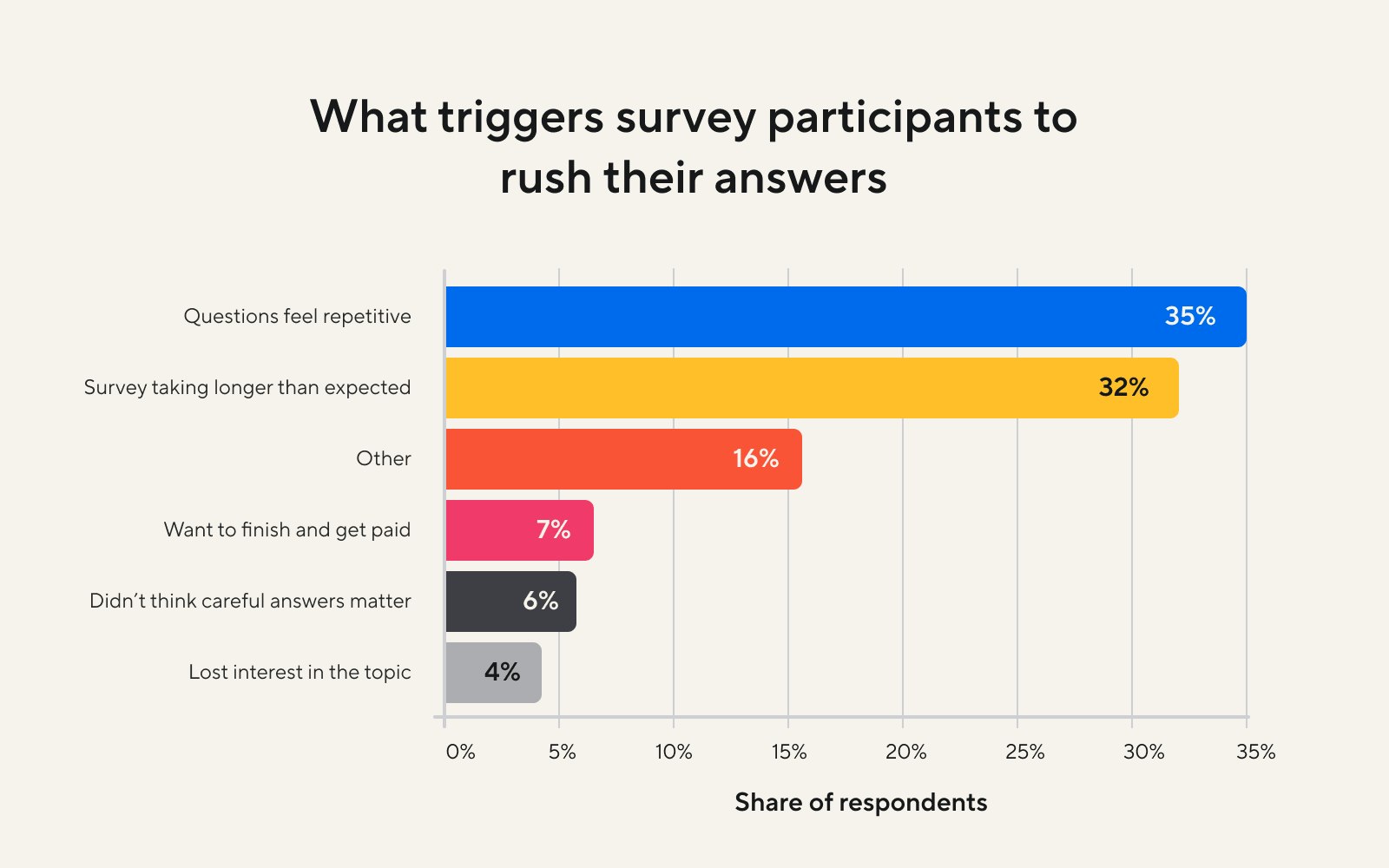
But the rest of our findings complicate this clear picture. When asked what triggers rushing, respondents had very specific answers: 35% pointed to repetitive questions, and 32% said surveys that take longer than expected. When asked at what point they start checking out, 32% said after a large block of similar questions, and 33% said when they realize the survey will take longer than estimated.
These answers suggest that most participants do rush through questions at least some of the time.
Social desirability bias may be at play here. Research participants take their role seriously and don't love admitting they cut corners.
The takeaway: Design your surveys around the assumption that satisficing (opting for good enough rather than optimal) happens, even when self-reported data suggests otherwise.
5. Repetition can encourage rushing
When comparing what makes participants rush through a survey versus what makes them quit entirely, two distinct patterns showed up.
Repetitive questions are a top trigger for rushing (35%) but barely register as a reason for quitting (4%). Technical problems are the opposite: they're the leading reason people quit (39%), but they don't seem to factor into rushing at all.
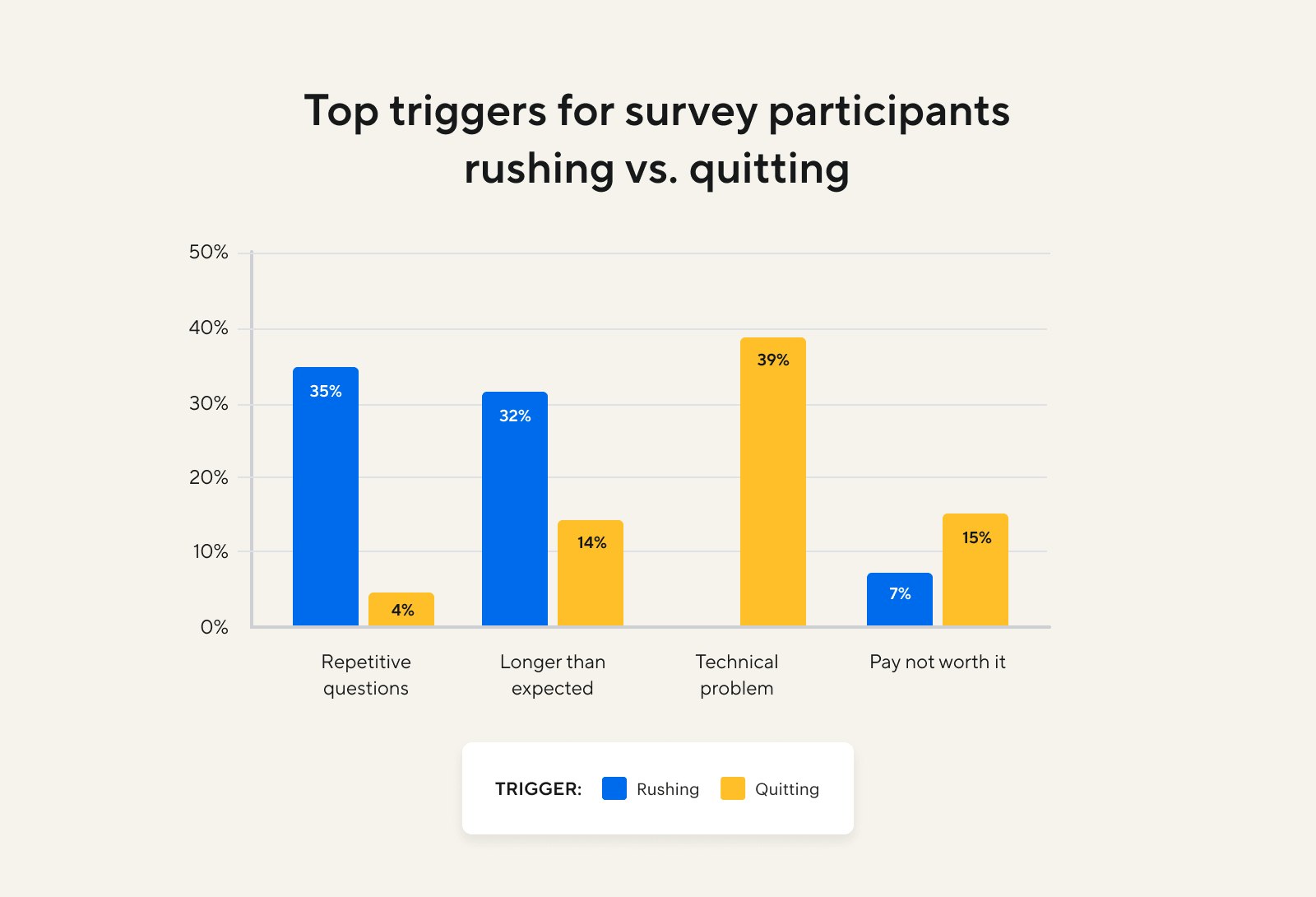
These two failure modes look different on the ops side. When someone quits, it shows up in your completion rate. But when someone starts rushing or is just mentally checked out, you won’t necessarily know unless their overall completion time is obviously too fast.
The takeaway: Avoid repetitive questions to hold participants’ attention. Plus, assess both survey abandonment rates and completion times to make sure you’re not overlooking critical performance issues.
6. Survey participants are susceptible to sunk costs
When participants lose motivation but keep going, the reason is usually discouraging. 42% said they stay because they’ve already invested too much time to quit. Only 12% said the pay was what made a survey worth finishing.
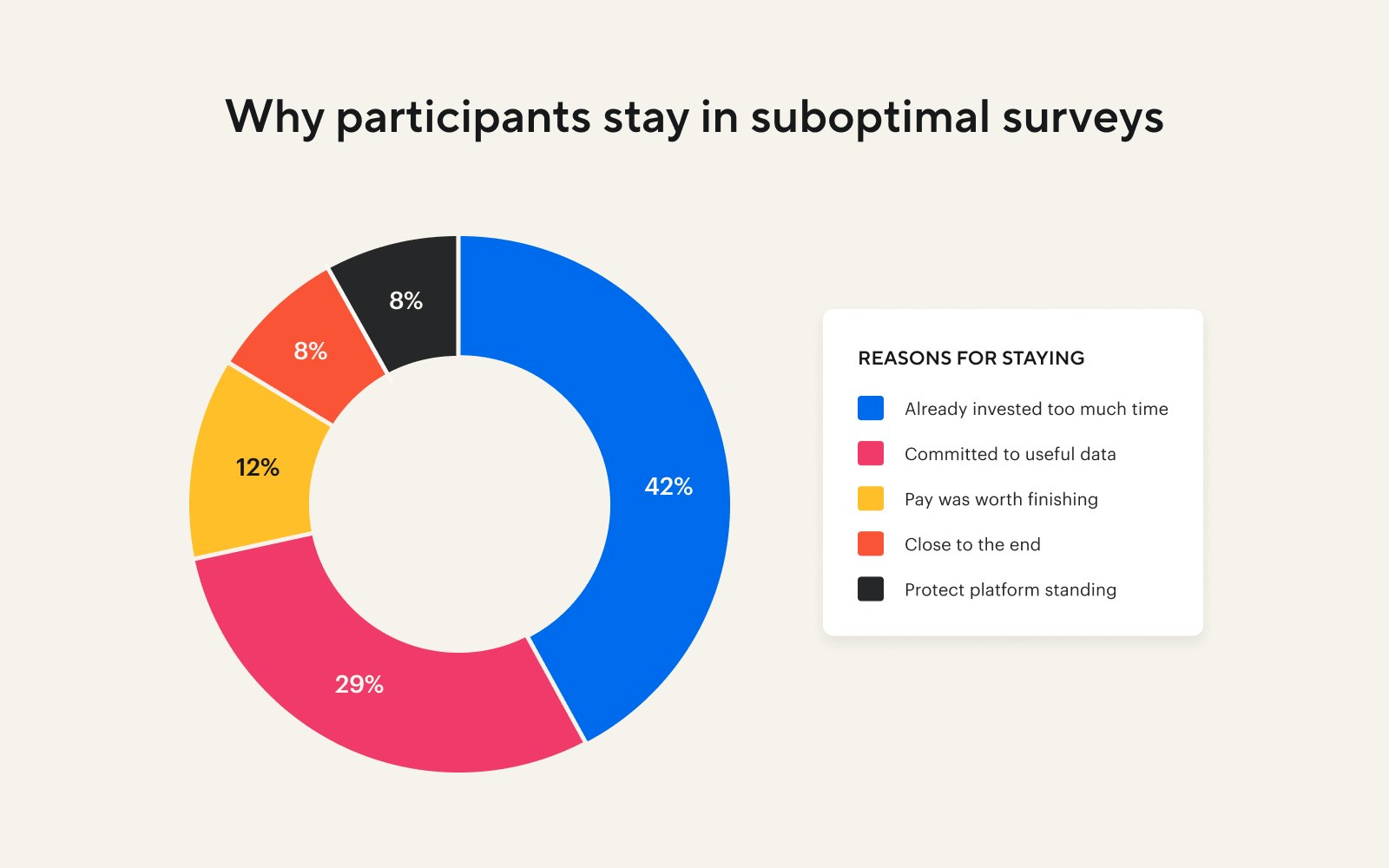
29% said they keep going because they felt committed to giving useful data. But the sunk cost finding deserves attention. A high completion rate doesn't necessarily mean you’re creating a positive participant experience. It could mean that people felt like they'd gone too far to turn back.
This also helps explain the satisficing gap we identified above. Participants who stay in surveys they want to leave probably aren't giving their best answers.
The takeaway: Consider including a quick 1-to-5 rating scale at the end of your study so participants can weigh in on whether or not they had a positive experience.
7. Disengagement is reversible if you build in recovery moments
Some good news: Only 3% of respondents said that once they lose interest, it doesn't come back. Most people can be re-engaged, and the tactics that work are well within your research team’s control.
37% said a change in question format pulled them back in. 29% said they re-engaged when they were closer to the end than they thought. And 17% were brought back by a question that felt more interesting or personally relevant.
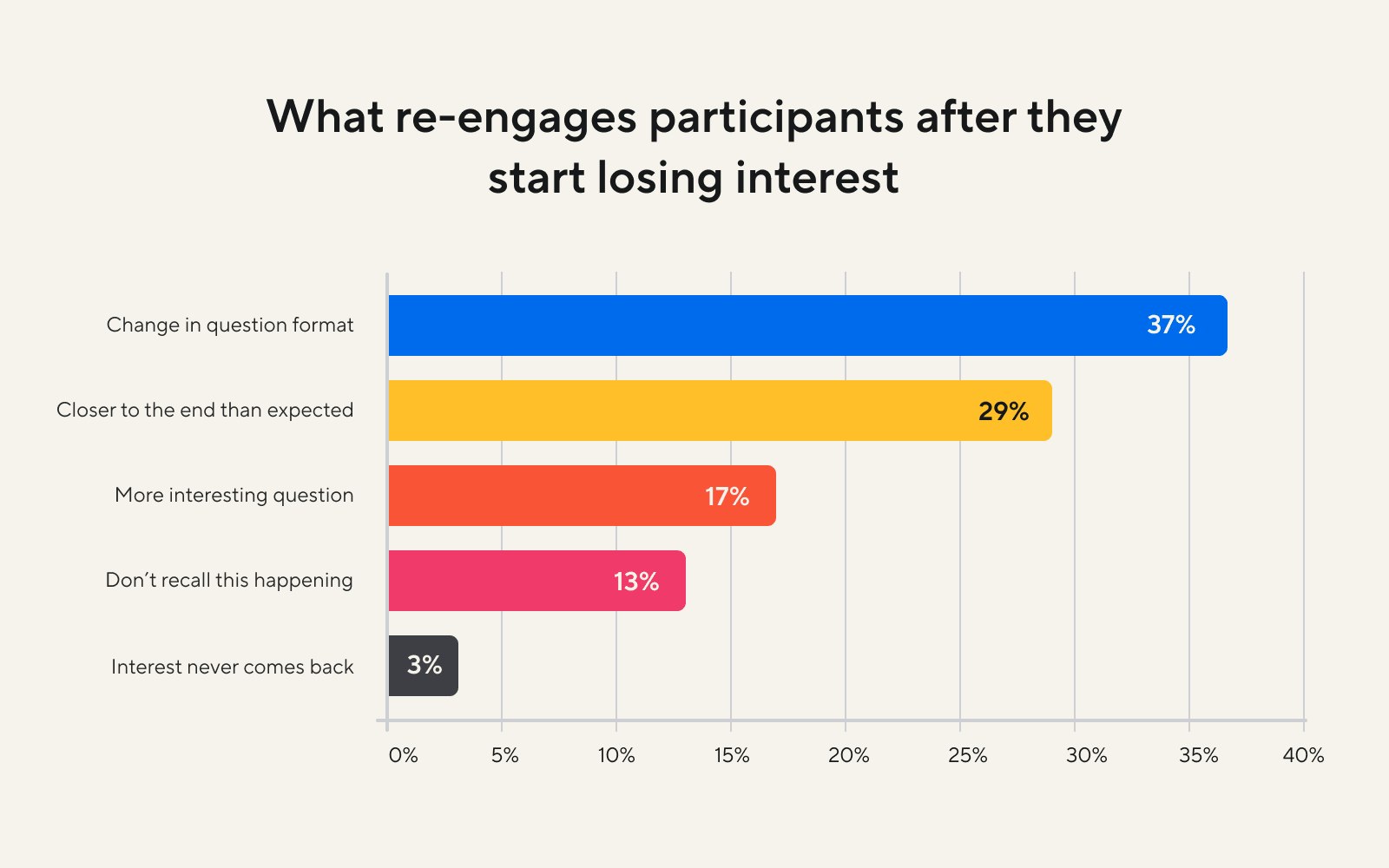
Key takeaway: If the first ten questions in your survey are all multiple choice, introduce a rating scale or open-end question in the back half for variety. Make progress visible, and if you have a genuinely compelling question, don't waste it in the first third where engagement is already high.
8. Multiple choice is the most engaging format
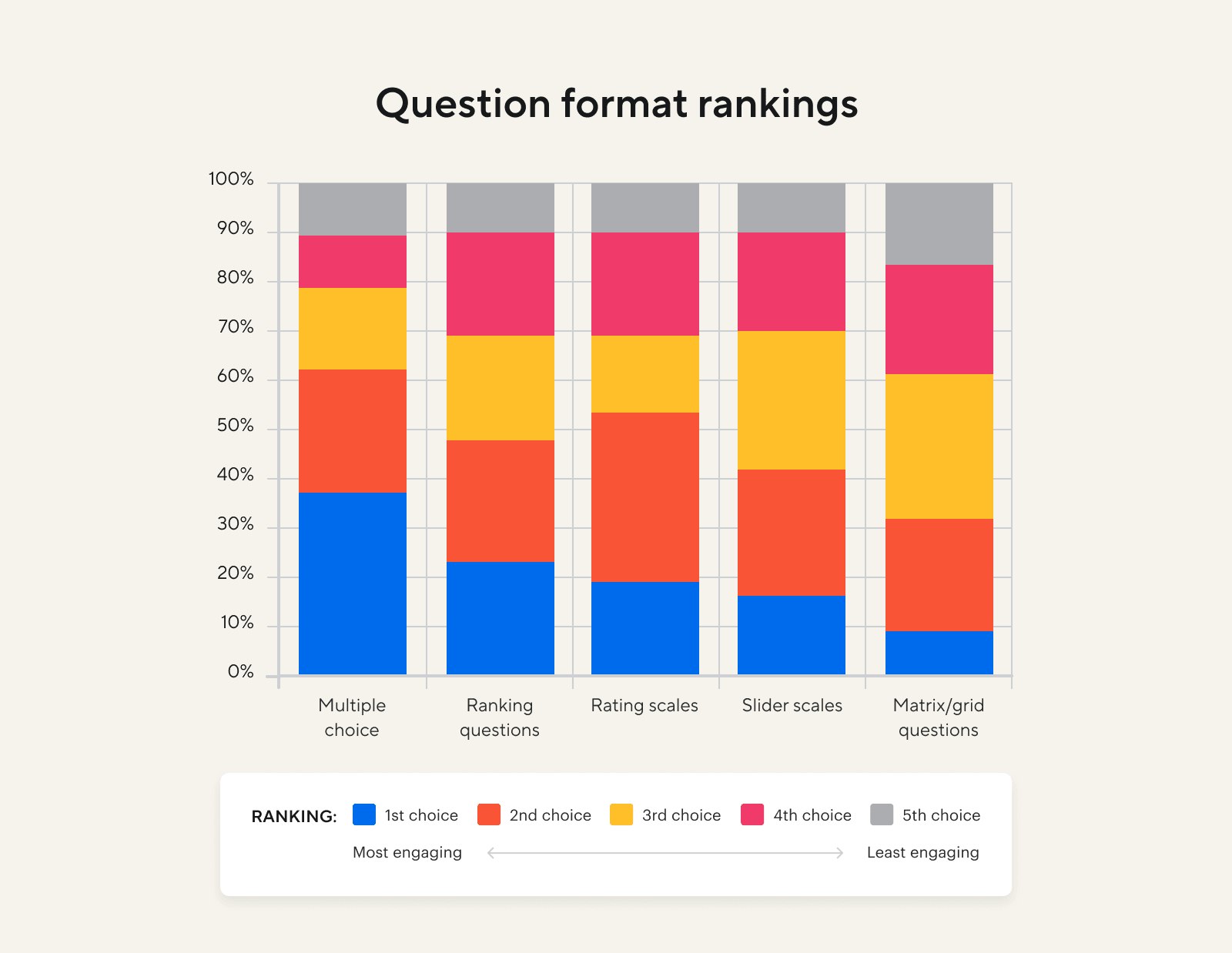
When participants ranked five common question formats, multiple choice came out on top. 38% ranked it as the most engaging, more than any other format. Rating scales and ranking questions clustered in the middle. Matrix grids landed near the bottom: only 9% ranked them first, and they had the highest share of last-place votes.
One more finding worth noting: mid-survey break points were more polarizing than other design choices. 28% said they'd appreciate a pause, and 31% said it would help a little. But 21% said they'd find it annoying and would rather push through. Unlike progress bars, this one doesn't have a clear consensus, so use your judgment based on survey length.
Key takeaway: Lean on multiple choice, ranking, and rating questions. Use sliders and matrices sparingly.
Survey design implications
Front-load your most demanding questions. Engagement is highest early and fades in the back half. Don't save your hardest or most important questions for the end.
Vary question format deliberately. Monotony is the primary engagement killer, not boredom with the topic. Break up long runs of the same question type, especially rating scales and matrix grids.
Use progress bars. There's no argument against them. Participant preference is as close to unanimous as our data gets.
Treat completion rate as an incomplete metric. Strong completions can mask a bad participant experience. Sunk cost bias keeps people in surveys well after their engagement has waned.
Pilot surveys to gauge actual completion time. Mismatched time expectations are a top trigger for both disengagement and rushing. Calibrate your estimates with soft-launch data.

Methodology
We surveyed 102 active research participants in the United States and Canada in May 2026. All respondents had completed at least 10 other surveys over the previous 30 days. The survey questions covered mid-survey engagement, design preferences, disengagement triggers, and recovery patterns.


